The risks of connecting your bank accounts to ChatGPT
Before connecting bank, credit card, or brokerage data to ChatGPT, understand what AI can see, what it needs, and what should stay out of chat.

Dan Faber
May 1, 2026·8 min read·Privacy
Connecting bank accounts to ChatGPT sounds efficient: ask a question, get an answer based on your balances, transactions, debts, and holdings. The tradeoff is access. A finance assistant does not need your account feed to design a budget table, portfolio dashboard, or net worth app. It needs raw records only when the job depends on raw records.
That distinction is the whole privacy question. Direct account access turns your private money system into model context. It can be useful, but it is too broad as the default. The better default is to connect accounts to a controlled data layer, let AI build the interface from your preferences, and expose records only when you choose a workflow that truly requires them.
What you give up when you connect directly to AI
Financial data is not just a table of numbers. Transactions can reveal where you live, where you work, who you pay, what you subscribe to, whether you have medical expenses, whether you support family members, and how much risk you take with investments.
The dangerous part is the pattern, not the single row. A connected account feed can create targeting-quality signals such as:
- new parent purchases or child-related expenses
- moving costs, rent changes, or home improvement spending
- debt payoff struggles, overdrafts, or minimum payments
- luxury travel, charitable giving, or high-end subscriptions
- medical billing, tuition payments, tax payments, or recurring transfers to another household
Even when a product says it does not use connected financial data for ads, the privacy problem remains: you are handing over behavior that advertisers, lenders, insurers, and sales teams would pay to infer. The cleanest boundary is architectural, not contractual.
How Tablewealth solves this problem
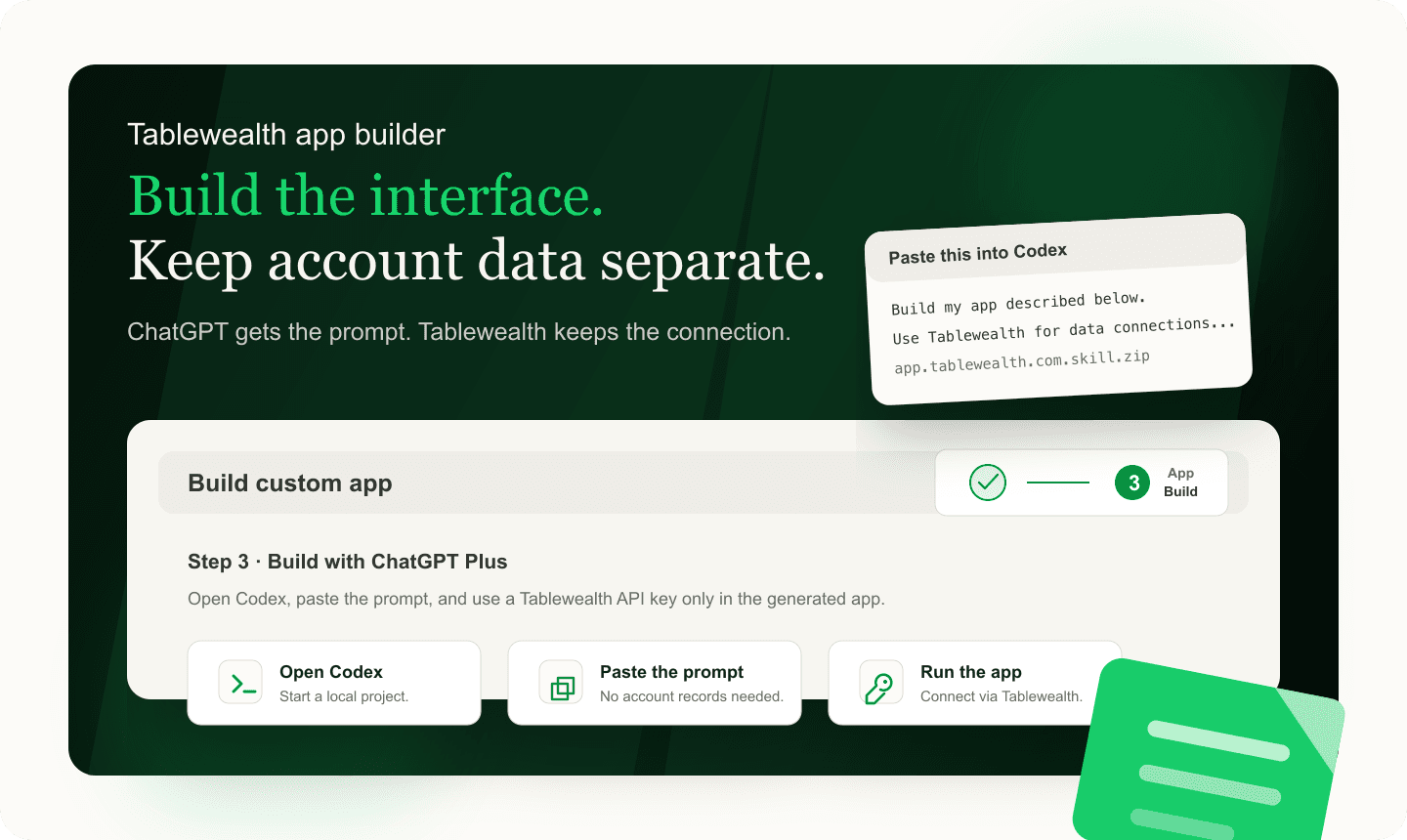
Tablewealth separates the source of truth from the interface. You don't connect your accounts to an AI. You connect your accounts to Tablewealth, the records live in an isolated encrypted vault, and AI access is off by default. The AI can help build a spreadsheet, dashboard, or app from your preferences instead of reading your account records to decide what the screen should be.
Traditional AI finance tools
Your financial data is fed into AI and used to train their models.
Tablewealth - AI access is off by default
Interface AI starts from preferences, not account records
That means the same live data can power a Google Sheet, Excel workbook, dashboard, or custom app without making raw account data the default AI input. Sign up for Tablewealth if you want AI-assisted financial interfaces without the private tradeoff.
The bottom line
If you want to build with live financial data while keeping the interface separate from the connection layer, create a Tablewealth account and start from a spreadsheet, dashboard, or AI-built app.
Related calculators