Roth conversions: how to find a good year to pay the tax
A lower-income year can open a Roth conversion opportunity. Learn how to compare partial conversions, estimate the tax cost, and check the five-year rules.

Dan Faber
September 12, 2026·7 min read·Investing, Retirement
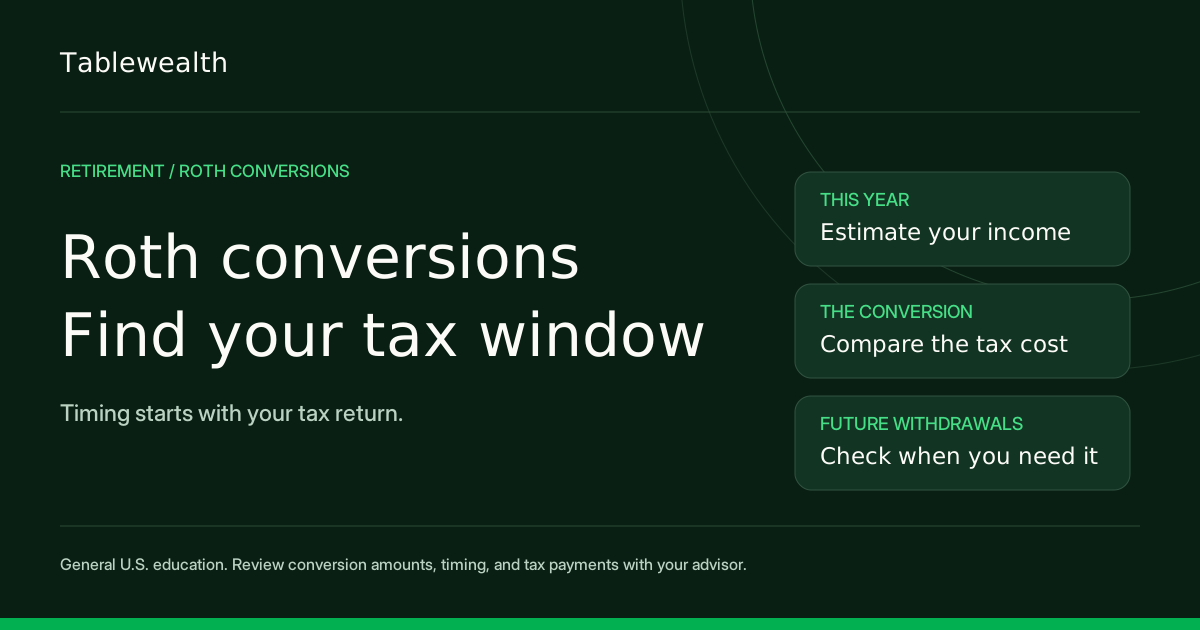
A useful time to consider a Roth IRA conversion is a year when the tax cost of converting is lower than the tax cost you expect on future withdrawals. That might be a year between jobs, a period of lower business income, or early retirement before other income begins. A market decline can also change the calculation, but a cheaper portfolio does not automatically make the tax bill affordable.
September is a practical time to start the review. You have much of the year’s income behind you and time to estimate bonuses, investment distributions, deductions, and cash needs. The goal is to choose an amount that fits the whole tax return, with enough time for the custodian to process it.
What a Roth conversion actually changes
A conversion moves money from a traditional IRA into a Roth IRA. As the IRS IRA conversion guidance explains, previously untaxed amounts become taxable. The potential benefit is future tax-free qualified Roth withdrawals; the tradeoff is paying tax on the taxable conversion now. This article focuses on an owner’s traditional IRA, rather than inherited IRAs or the separate distribution rules for workplace plans.
Conversion eligibility also differs from regular contribution eligibility. The IRS Roth IRA overview notes that income does not itself prevent a traditional-to-Roth conversion. Converting existing retirement money is separate from the annual allowance for contributing new money. A high earner who cannot make a direct Roth contribution may still be able to convert eligible IRA assets.
For the separate limits on new retirement savings, see our 2026 401(k) and IRA contribution guide. Keep contributions, conversions, and ordinary transfers in separate rows of your records.
Look for a lower-income year before looking for a market bottom
| Possible window | Why review it? | What could change the answer? |
|---|---|---|
| A gap between jobs | Lower annual wages may leave room for conversion income | Severance, a signing bonus, or a spouse’s earnings |
| Early retirement | Income may be lower before Social Security, pensions, or required withdrawals begin | Living expenses, health coverage costs, and future income |
| A lower-income business year | A temporary income dip may reduce the cost of recognizing income | Late-year revenue and uncertain deductions |
| A portfolio decline | The same shares may have a lower taxable conversion value | Current tax rates, further losses, and cash available for tax |
Model at least this year and a plausible future withdrawal year. Someone in a peak earning year who expects substantially lower taxable income after retiring may have a reason to wait. Someone already in a temporary income gap may have a reason to investigate a partial conversion. Neither can know future tax law or investment returns with certainty.
Price the next conversion dollar, not just the average tax rate
A larger conversion can cross tax brackets. For a simple example, assume a tax projection leaves $30,000 of ordinary taxable income in a 22% bracket, with the next dollars taxed at 24%. Assume the conversion is fully taxable and changes no deductions, credits, capital-gain taxes, or other income calculations.
| Taxable conversion | Added federal tax in this example | Calculation |
|---|---|---|
| $20,000 | $4,400 | $20,000 × 22% |
| $30,000 | $6,600 | $30,000 × 22% |
| $40,000 | $9,000 | ($30,000 × 22%) + ($10,000 × 24%) |
The last $10,000 in the larger conversion costs $2,400 in this simplified example. Crossing the bracket does not reprice all the household’s earlier income at 24%. It does mean the next conversion dollars need to justify their higher cost. There is no requirement to convert the whole IRA at once.
Compare a smaller conversion, a larger conversion, and no conversion this year. For a fair long-term comparison, include the cash used to pay the tax and what that cash could otherwise do. Future Roth account value alone does not establish that a conversion improved the household’s after-tax wealth.
Check IRA basis and costs outside the tax bracket
If you have nondeductible traditional IRA contributions, the IRS Form 8606 instructions explain how basis affects the taxable amount. The calculation generally aggregates your own traditional IRAs, including traditional SEP and SIMPLE IRAs, using year-end values and the year’s distributions and conversions. Choosing an account that contains after-tax contributions does not isolate those dollars from the pro-rata calculation.
For Medicare, Social Security generally uses income from two years earlier to determine income-related premium adjustments. That means a taxable conversion can affect a later year’s premiums, even when the conversion year’s federal bracket looks acceptable.
Before Medicare, Marketplace coverage uses household income to determine financial help. Include taxable conversion income in that review. State taxes and changes to deductions or credits also belong in the projection; the federal bracket is only one part of the cost.
A market decline changes the price of converting the same shares
If the investments later recover inside the Roth, that future growth may benefit from qualified Roth tax treatment. They may also fall further. Waiting indefinitely for a bottom adds a market forecast to a decision that already depends on uncertain future tax rates.
There is also no routine undo button for a completed conversion: the IRS recharacterization rule prevents reversing post-2017 Roth conversions by recharacterizing them as traditional IRA contributions. A later price decline does not erase the original taxable conversion. Smaller conversions can leave room to reassess the remaining amount as the year develops.
Leave time for processing and decide how the tax will be paid
As Fidelity’s conversion Q&A explains, a conversion must be completed by December 31 to count for that tax year. Do not confuse that with the later deadline for regular IRA contributions. Confirm your custodian’s processing cutoff and leave a buffer; a request submitted at the last minute may not finish in time.
Budget the tax payment separately. The IRS withholding and estimated tax guidance describes when additional withholding or estimated payments may be needed. A year-end conversion does not automatically mean all related tax can wait until filing without an underpayment issue. Timing, withholding, prior-year tax, and payment-method rules matter.
Paying from cash outside the IRA can preserve the amount converted, provided that cash is affordable to use. The IRS rules for IRA conversions and rollovers explain why money withheld and not converted remains a distribution; before age 59½ it can also face an early-distribution tax unless an exception applies. Include that difference when comparing payment methods.
Check the two five-year rules before planning to spend the money
The IRS Roth distribution guidance distinguishes two clocks. Qualified distributions generally require the Roth IRA five-tax-year holding period plus age 59½ or another qualifying condition. Separately, each conversion has a five-tax-year period that can trigger a 10% additional tax on early withdrawals of its taxable converted amount, unless an exception applies. The clocks serve different purposes, and withdrawal ordering rules matter.
For a calendar-year taxpayer, a conversion completed in September 2026 starts its conversion clock on January 1, 2026. Do not use that date alone to conclude that any later withdrawal is tax-free or penalty-free. Someone planning to spend the converted money soon should review both clocks, age, and exceptions before converting.
If required minimum distributions apply, the IRS rollover rules exclude RMDs from rollover eligibility. Account for the required withdrawal first; the RMD itself cannot be converted to a Roth IRA.
Bring three scenarios to your advisor this September
- Collect year-to-date income, expected remaining income, deductions, prior-year tax, IRA balances, and nondeductible basis records.
- Compare no conversion, a smaller partial conversion, and a larger one on the same projected tax return.
- Include state taxes, healthcare effects, cash needed for tax, and the timing of future withdrawals.
- Confirm RMD requirements, conversion eligibility, processing deadlines, and the tax-payment plan with the appropriate professionals.
- Save the completed conversion confirmation and keep it with the tax records for that year.
Use the Tablewealth estimated tax calculator for an initial payment estimate after determining the taxable conversion amount. It does not calculate every conversion-specific rule, Medicare surcharge, or Marketplace subsidy effect. Bring the scenarios to a qualified financial advisor and tax professional to choose an amount that fits your household.
Related calculators