How to use ChatGPT with your finances without paying $1,200/year
You do not need a separate expensive AI finance subscription just to ask ChatGPT questions about your own accounts. The better model is a controlled financial data layer with read-only access.

Dan Faber
June 15, 2026·7 min read·AI Finance
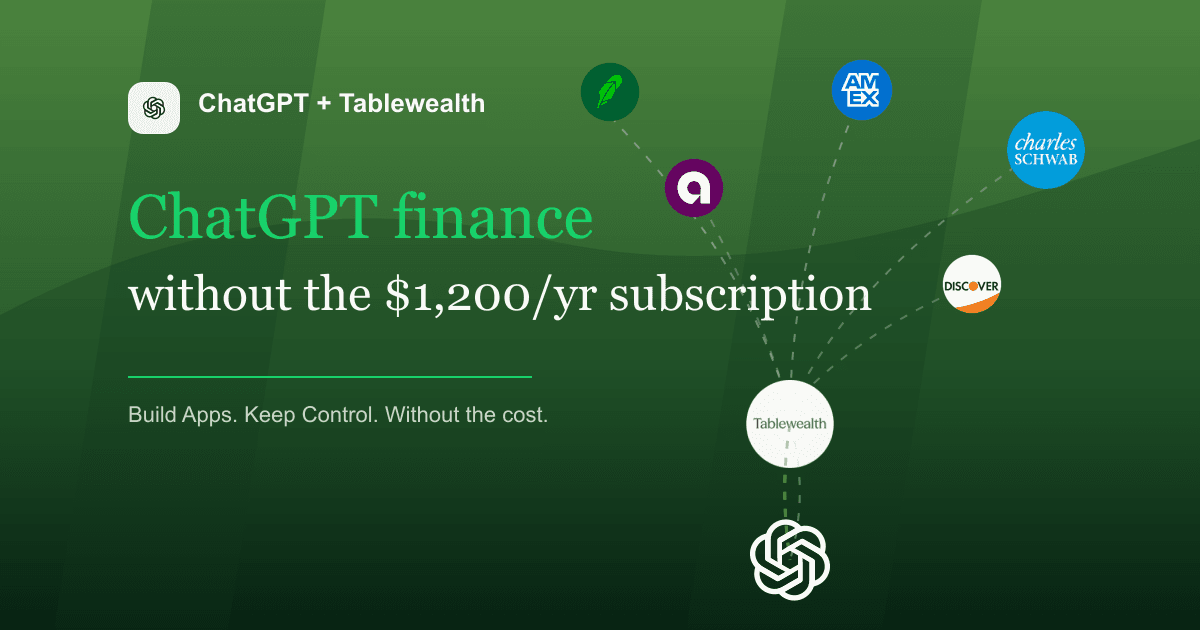
Connecting your finances to ChatGPT should not require handing your whole money life to another finance app.
The expensive version of this idea is familiar: pay for a polished AI finance subscription, connect your bank accounts, and let the product decide what questions you can ask. That can work. It can also turn a simple need into another yearly bill and another permanent copy of your financial data sitting inside someone else's system.
The better version is simpler. Keep your financial data in a controlled layer. Give ChatGPT read-only access only when you want analysis. Ask questions in plain English. Revoke access when you are done.
That is what Tablewealth's MCP connector is built for.
The problem is not ChatGPT
ChatGPT is good at turning messy questions into structured analysis.
It can help summarize spending, compare account balances, explain cash flow, spot unusual transactions, and turn a list of holdings into a concentration view. The problem is not the model. The problem is the default data path.
If you paste transactions into chat, you create a manual privacy problem. If you connect every account to a finance app just to get an AI assistant, you create a subscription and access problem. If the assistant can do more than read, you create a control problem.
"Financial data should not move through an AI tool just because the interface is convenient."
What ChatGPT actually needs
Most finance questions do not require unlimited access.
If you ask, "How much did I spend on restaurants last month?", ChatGPT needs transactions for that date range and category. It does not need your full account history, your login credentials, or permission to move money.
If you ask, "What changed in my net worth?", it needs current balances and a comparison point. It does not need to trade your portfolio.
If you ask, "Where am I most concentrated?", it needs holdings and market values. It does not need write access to your brokerage.
That boundary matters. The safest finance assistant is not the one that can do everything. It is the one that can read the right records, answer the question, and stop there.
How Tablewealth fits
Tablewealth keeps the financial data layer separate from the AI surface.
You connect accounts, imports, spreadsheets, and manual records to Tablewealth. Then ChatGPT can connect to Tablewealth through a read-only MCP connector. MCP is the protocol that lets AI assistants call specific tools instead of receiving one giant export.
In practice, that means ChatGPT can ask Tablewealth for bounded data:
- list accounts
- get account balances
- list holdings
- summarize portfolio allocation
- summarize net worth
- summarize cash flow
- summarize spending by category
- search transactions
- check data freshness
Those tools are read-only. They retrieve data. They do not edit accounts, initiate transfers, place trades, or change your financial records.
A practical setup
Start with the data layer.
Create a Tablewealth account, connect the accounts you want to analyze, and add manual assets or liabilities that do not come from a live connection. Then connect Tablewealth to ChatGPT and choose the scope you are comfortable with.
A conservative first setup is:
- read-only access
- only the organization you choose
- only the accounts you want ChatGPT to see
- no write tools
- no money movement
Once connected, ask specific questions:
The important part is that the request stays bounded. ChatGPT should receive the records needed to answer the question, not a permanent all-access export.
Why this is different from a finance chatbot
A finance chatbot usually asks you to trust the whole product.
Tablewealth is trying to make the trust boundary more explicit. Your connected records live in Tablewealth. ChatGPT gets a controlled tool interface. You can review the connection, limit account access, and revoke it.
That does not make every AI finance workflow risk-free. It does make the architecture easier to understand:
- Tablewealth is the source of truth.
- ChatGPT is the analysis surface.
- MCP is the read-only bridge.
- You decide what crosses the bridge.
"Useful when you ask. Quiet when you do not."
What to avoid
Do not paste full account exports into a chat just because it is fast.
Do not connect financial accounts to tools that cannot explain what they read, how long they keep it, and whether they can take action.
Do not give an AI assistant trading, transfer, or bill-pay permissions when your actual use case is analysis.
And do not pay for another expensive subscription just to ask questions about data you already own.
The bottom line
ChatGPT can be useful for personal finance, but the setup matters.
The goal is not to make AI your financial institution. The goal is to let AI analyze the records you choose, through a narrow read-only connection, without turning your private money system into a default model input.
Tablewealth gives you that middle layer: connected financial data, scoped access, and a way to bring ChatGPT into the workflow without giving up control. Create a Tablewealth account to connect your data layer before you connect your AI layer.